
Case study for Zaptec
A UX casestudy for public EV chargers
Skills used
A case study using Lean UX exploration with Zaptec
As part of an interview process with Zaptec, a conceptual exploration was undertaken to assess the feasibility of public sharing of private EV chargers. The Lean UX methodology, known for its iterative and user-focused approach, provided a clear roadmap for this case study.
What is Lean UX?
Lean UX is a design methodology that emphasises fast iterations, early user feedback, and a minimalistic approach to documentation. Instead of waiting for a 'perfect' design, Lean UX promotes the development of a minimal viable product (MVP) that can be tested and improved upon. It aligns well with agile development processes and prioritises user experience at its core.
Why choose Lean UX for this project?
Given that this project was a case study and relied heavily on assumptions, Lean UX was aptly suited. It facilitated a structured approach to validate these assumptions rapidly, making it ideal for a scenario where in-depth market data might be limited.
Lean UX for this Case Study was broken into 4 parts: Think -> Design -> MVP -> Check -> Repeat, until something is validated for release.
Think: Setting the stage
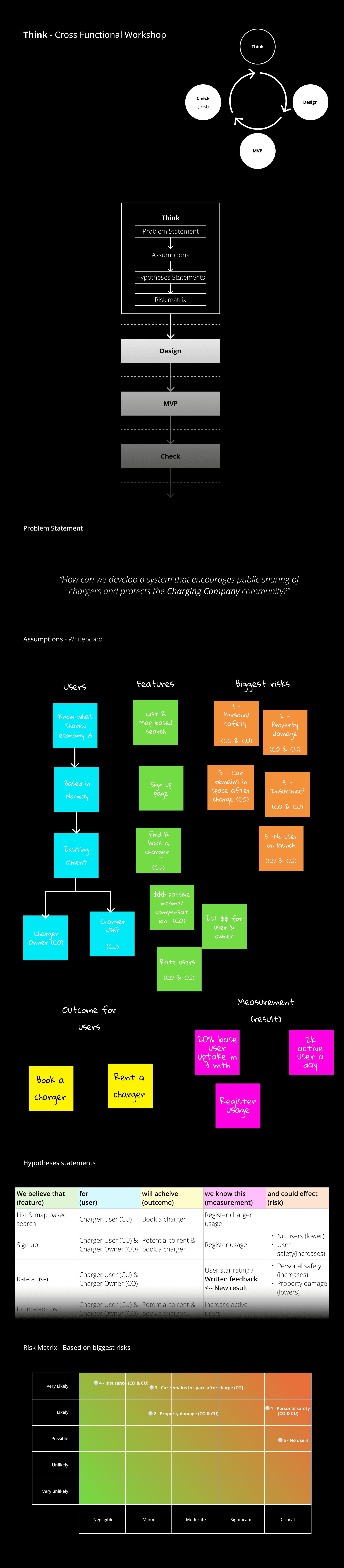
The 'Think' phase sets the foundational logic for the entire project, focusing on critical assumptions and potential risks.
Problem statementUnderstanding the challenges and opportunities in making private EV chargers publicly accessible.
AssumptionsListed were key assumptions about user behaviours, technology compatibility, and market readiness for such a transition.
Hypotheses statementsBased on these assumptions, testable hypotheses were formulated to guide the design and validation process.
Risk matrixA comprehensive matrix was developed to evaluate potential pitfalls and challenges, ensuring possible obstacles remained visible.
Design: Shaping the solution
In the 'Design' phase, energy was channelled into creating user-centric designs to address the problem statement.
PersonasMultiple personas were crafted, representing various user groups and their distinct needs in the EV charging space.
User journey mapsThese maps provided a step-by-step walkthrough of user interactions, identifying potential touchpoints and pain areas.
WireframesEarly-stage design mockups were developed, giving a visual representation of the user interface and interaction flow.

MVP: Building the prototype
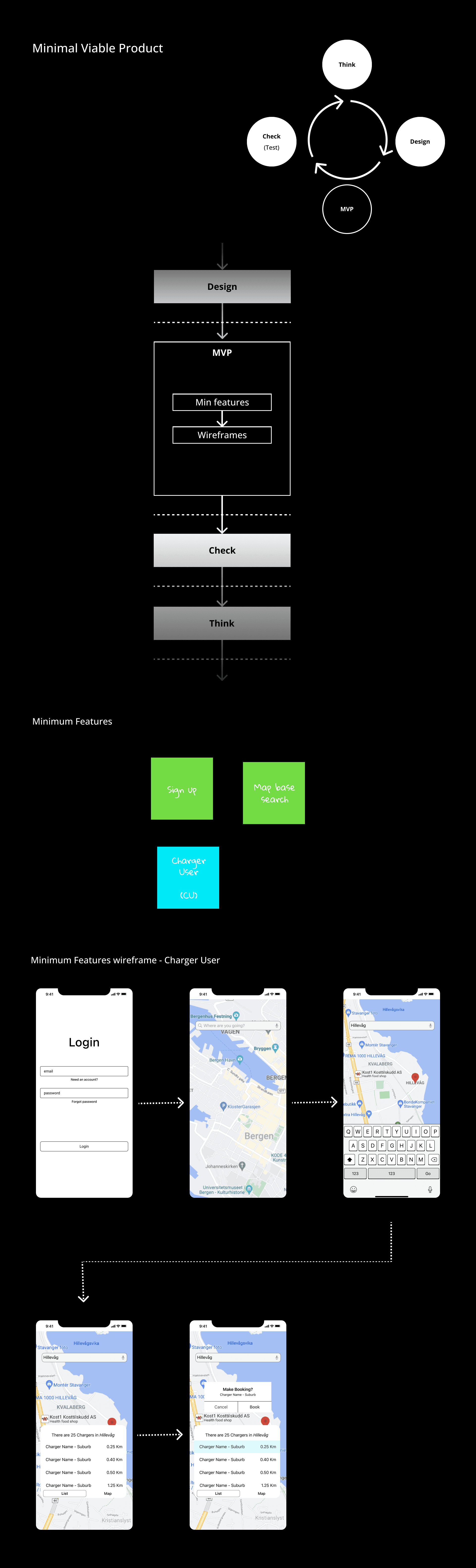
This phase concentrated on distilling the designs into a functional MVP, built around core features and user experience.
Minimum featuresA select set of features deemed essential for the initial user testing phase was prioritised.
WireframesRefined wireframes for the MVP were crafted, ensuring a seamless and intuitive user experience.
Check: Evaluating the MVP
In the 'Check' phase, the MVP was put to the test, seeking validation for the hypotheses and assumptions.
Did it answer the MVP assumptions?The MVP was assessed against the initial assumptions to determine its alignment and accuracy.
Risk reductionComparison with the risk matrix identified areas where risks were mitigated and areas still demanding attention.
Is it ready for release?An in-depth evaluation was conducted to ascertain if the MVP was ready for a broader audience or needed further refinement.
What needs to be fixed?Feedback loops helped identify areas of improvement, from feature enhancements to usability tweaks.
Is the idea valid?The ultimate question was addressed: Did the MVP validate the initial idea or did it necessitate a pivot?
Conclusion
The Lean UX approach, with its cyclical nature, ensured that the product was continually refined and reassessed until deemed ready for release. This case study, albeit conceptual, serves as a testament to a methodical, user-centric, and iterative approach to design and validation in the ever-evolving EV charging domain.